The Floodlights Come On in Aurelia

Rain shines on the concrete terraces as twelve club chairs take their places beneath Aurelia Municipal Ground. They expected a grant; you put a shared-ownership charter on the table instead.

CountryGov is a political adventure game about power in a living, fictional world. Step into a nation with its own history, culture, and place among other countries. Then govern its institutions, explore its places, meet its people, and decide what kind of country it will become.
Write an action. Story stages what happens. Its effects become part of the world—institutions, relationships, strengths, issues, agreements, and consequences that persist.
InstitutionCreatedDraventhal National LeagueTwelve founding clubs, regional academies, shared ownership rules, and a national competition calendar. PracticeCreatedThe Meridian ChampionshipValmere accepts the invitation. Two other governments want broadcasting terms before joining.
The world decides what it costs, who resists, what changes—and whether it works.
You are powerful. You are not the centre of everything. Beyond your borders, nations have their own histories, cultures, and ambitions. Elections unfold. Governments fall. Alliances shift. Industries rise and decline. Projects advance. Crises deepen. As you discover this world, its people make plans—and sometimes act before you do.
Before dawn, the eastern wall folds into the harbour. Ferries turn back toward open water as crews race to move fuel and grain above the surge line.
No one in Draventhal caused it. By morning, shipping prices are already moving.
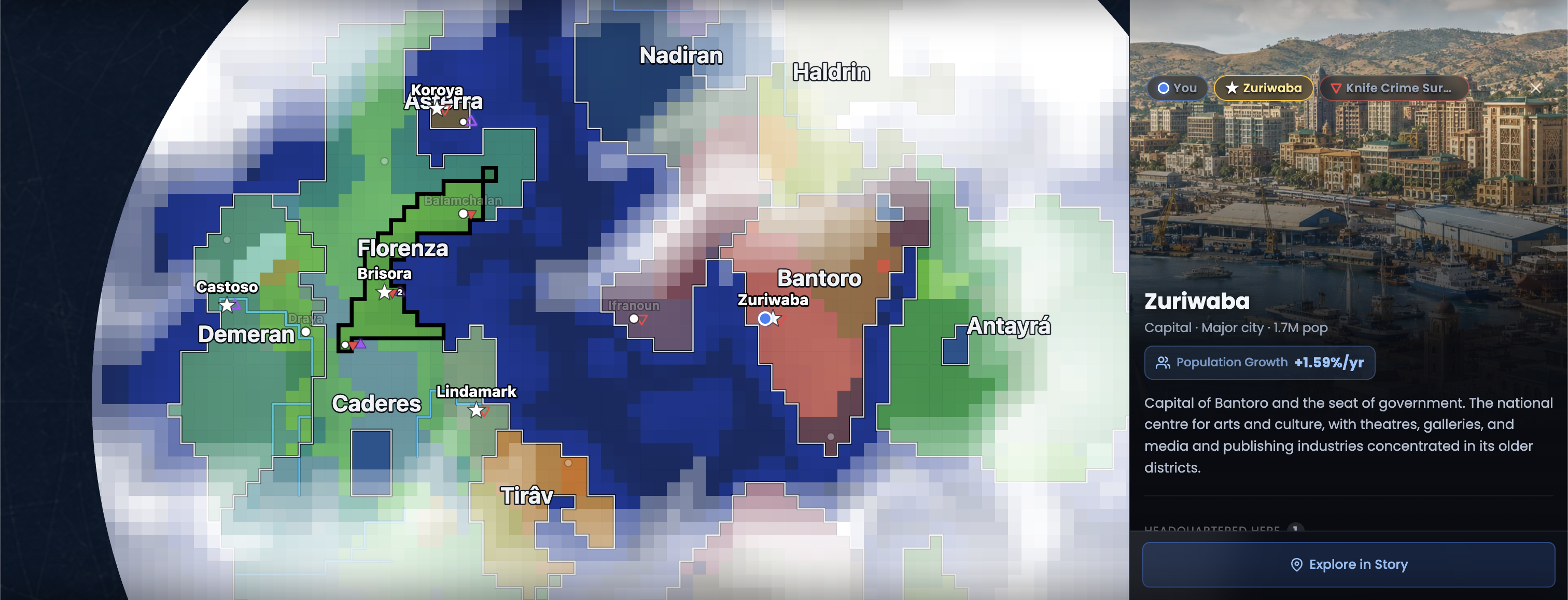
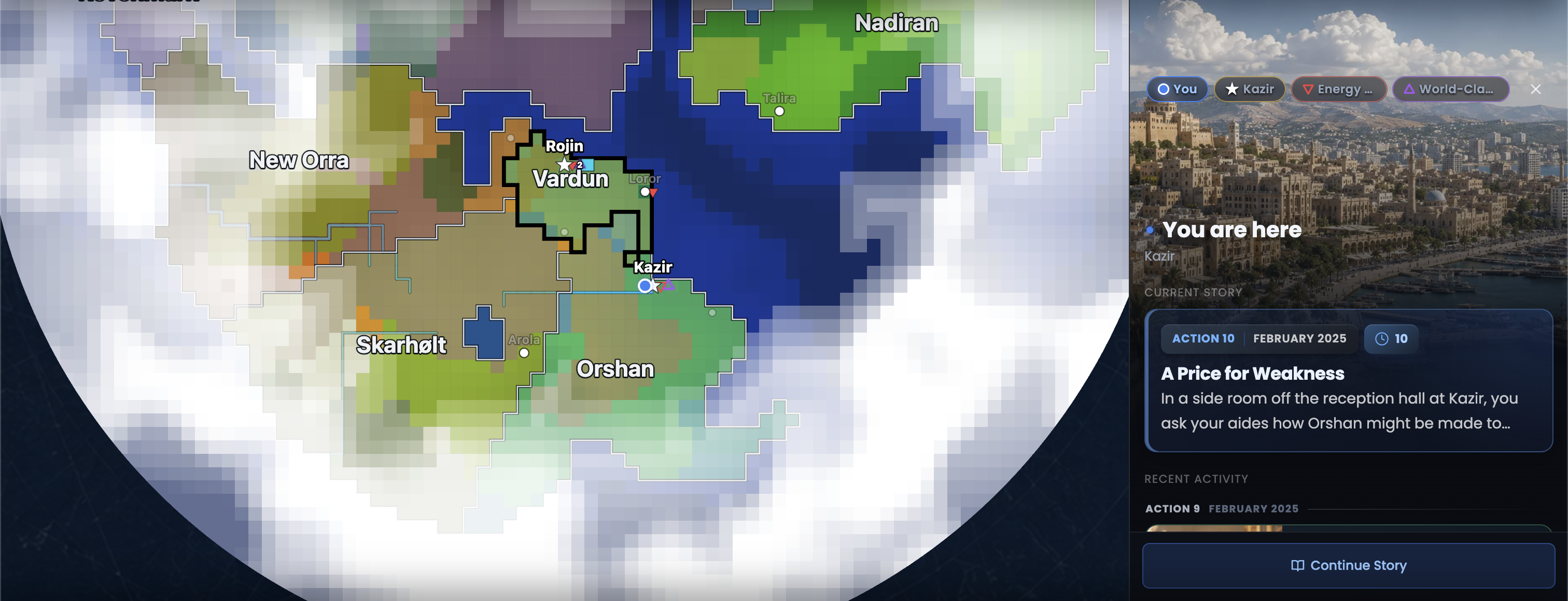
Travel through your country and across the world: a mining town, a foreign capital, or somewhere discovered by accident. Travel is how you uncover the world. Discover local customs, go where an issue is unfolding, and meet the people living through it. Some things only make sense once you arrive.
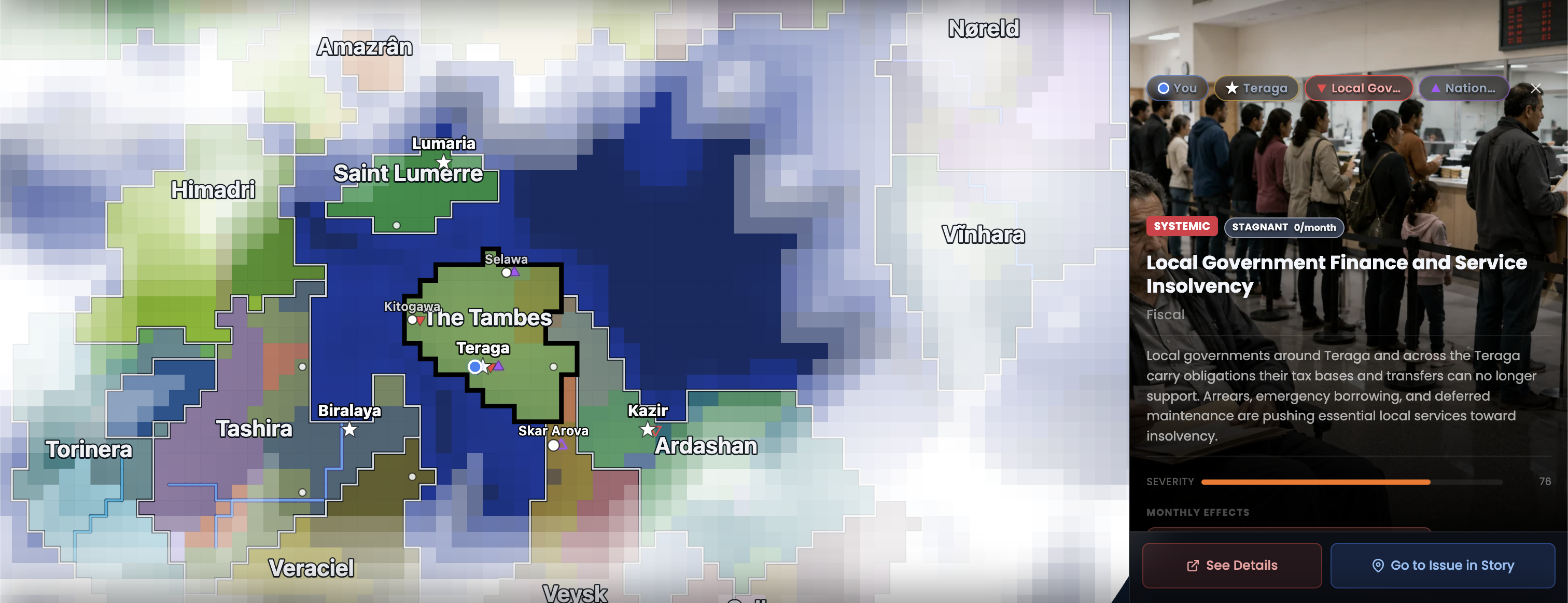
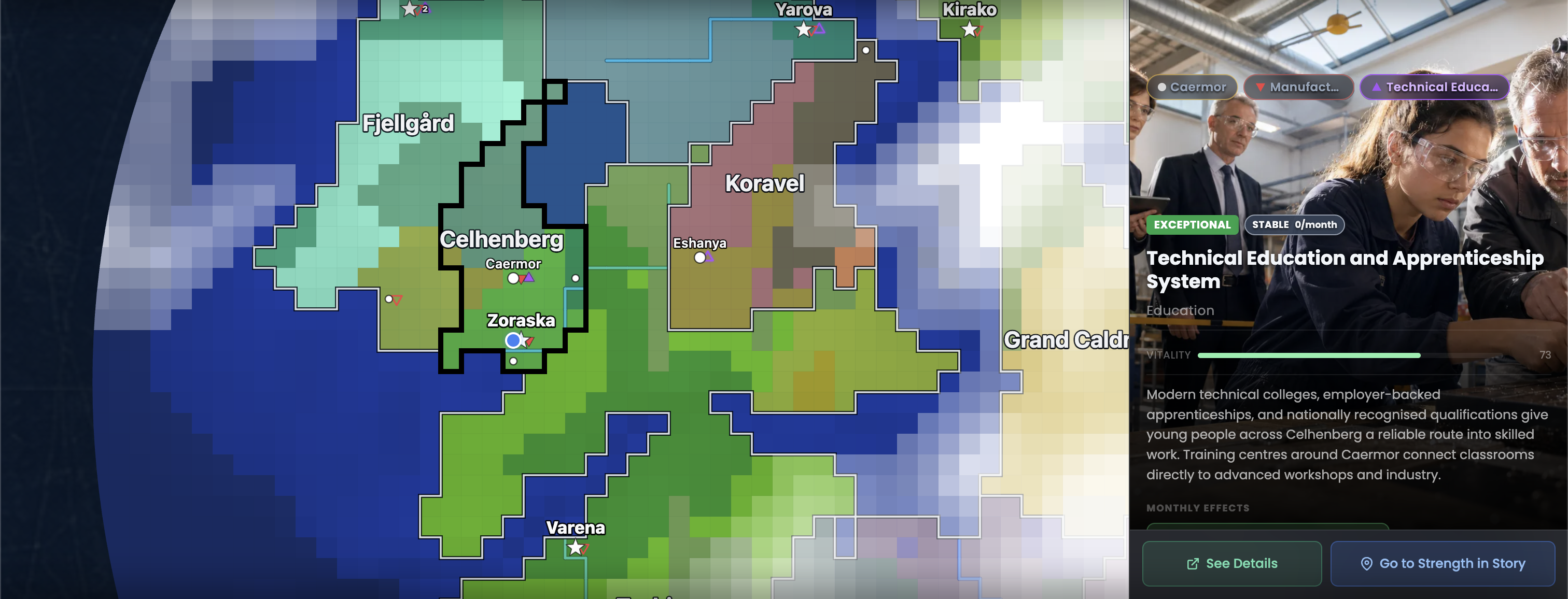
Govern through what is already there. Issues demand judgment; strengths create leverage. Both have histories, constituencies, and consequences.
Problems have causes. Confront their foundations, manage their symptoms, or decide what must wait.
Real wages have trailed inflation for three years. Household spending is falling and industrial unrest is growing.
Advantages need stewardship. Protect what works, invest in it, and turn inherited capability into future power.
Assembly plants, component suppliers, and engineering houses employ hundreds of thousands and anchor the industrial economy.
Lead a democracy or rule an autocracy. The constitution decides who can stop you, whose support you need, and how an intention becomes state action.
Your party’s seats are only the beginning. Draft legislation, negotiate support, face exact votes, and survive the elections that decide whether you keep governing.
Issue decrees and manage the institutions that make authority real. Each bloc has its own domestic power, attitude, identity, and capacity to support—or frustrate—your rule.
Decisions become history. Promises can be fulfilled, abandoned, or betrayed. Relationships accumulate trust and resentment. Projects remain in the world. Places acquire stories. Institutions reflect the choices that shaped them.
 Promise fulfilledKeep the river compact localShared municipal control remains intact through the first construction milestone.
You trusted the river towns with their own institution—and kept that promise when national officials pushed to take control.
CountryGov has systems. Your imagination does not have to fit inside them.
Attempt anything the world can understand.
Worldbuilding is part of the game. Author a country’s geography, culture, institutions, economy, and political traditions—or inherit a nation whose history has already begun. Give it a character you want to explore, then discover what living in and governing it brings.
Build a country from first principles
Take responsibility for a country in motion
 DemocracyAnglosphere Cosmopolitan
Constitutional Principality
11 Foundation Points. Strong in Economy & Industry. Vulnerable in Infrastructure & Environment.
Every system touches the others. Explore one and discover how it changes the country around it.
The world is already in motion. It will not wait.
Start New Game
Inherit a Country
Begin governing immediately, or customize your country first.


Story repeatedly changed what kind of writer the AI was supposed to be: assistant, political narrator, scene engine, and finally an accessible dramatist.
Where it arrived: political adventure prose for an intelligent general audience—plain enough to parse, specific enough to govern, and still atmospheric.
Streaming, conversation history, and a reusable Story component appeared, but prose and simulation were still only loosely connected.
Evidence: 8339aba, a97af25, 8cd0ae8 · exact commits
Policy specificity, named characters, decision cards, openings, and visible consequences established the recognizable Dungeon Master voice.
Evidence: 69ad0a5, 1bc9958, 85d8259 · exact commits
Administrative summaries and forced checklists gave way to a political scene whose mechanics followed from what actually happened.
Evidence: 27821b4 · exact commit
Story was rebuilt around a concrete live scene, player agency, and meaningful choices. Repetitive monthly recaps were removed and continuity came from actual conversation history.
Evidence: 5158ce7, 26e5b9e, 156e814, 79e82f, 9015b94
The DM learned to infer intent, avoid forced headings, write human exchanges, accommodate many play styles, and stop at a genuine decision instead of a generic reflection.
Evidence: 2c35ad4 through 6ba1e1d · bounded commit sequence
Openings, actions, and transitions gained one identity. The country became a place people inhabit; time had to move; length followed drama rather than a rigid ceiling.
Evidence: 1dc1325, 73e2b92, 9502d6e, 95e8369, e3ec6a9, 31f7688
CountryGov stopped lecturing through country-specific legal minutiae. National laws and campaign-scale undertakings require Parliament; routine administration and scoped delivery remain executive.
Evidence: 99044e0 mega-patch, building on fd8091b
The game lowered the reading burden: recognizable things before professional shorthand, ordinary verbs before stacked technical nouns, and causal explanation before mechanism names—while preserving tension, character, and tone.
Evidence: 096232c · release snapshot
Continuing moments can run without a new title, and subtitles are removed. Prose follows the ongoing encounter, with headings reserved for meaningful breaks instead of packaging every response as a separate episode. Suggested next actions vary with the scene rather than always filling four slots. Clearer language and smoother prose make the story easier and more enjoyable to read.
Evidence: ai_service.py · v0.9 source
The technical history is a search for one trustworthy political judgment without starving that judgment of context.
Where it arrived: one final authorial adjudication writes the scene and its consequences together, after selective retrieval supplies the evidence and rules it needs.
One call wrote narration and another inferred statistical changes. This kept streaming fluid but allowed prose and mechanics to disagree.
Evidence: 95f1de9, 11859c1 · exact commits
The DM returned prose alongside machine-readable changes to statistics, World Memory, people, Issues, Promises, and legislation.
Evidence: c6dea98 · exact commit
Story authored the dramatic beat first and a later extractor interpreted it. Prose improved, but empty or contradictory payloads remained possible because interpretation was still separate.
Evidence: 5158ce7, 625bd84 · exact commits
Three separate opening, action, and transition streams were consolidated, reducing technical divergence between Story contexts.
Evidence: b32b41e · exact commit
A grounding planner began selecting relevant records, people, geography, conditions, legislation, and recent canon instead of relying on one enormous world dump.
Evidence: 99044e0 mega-patch, building on fd8091b
The final Story judgment came to author visible prose, hidden mechanics, links, visual intent, and playable branches together. “One-call” describes that unified final judgment; retrieval may still use a preparatory model call.
Evidence: 096232c mega-patch
Story can now ground its intended beat against full world records and specialized mechanics playbooks before the unified response, preserving intelligent judgment without rebuilding a giant prompt.
Evidence: 39a0c1f · release snapshot; internal ordering squashed
Events evolved from generated news after a turn into the composition layer for autonomous world motion.
Where it arrived: the world moves for concrete reasons, with quiet months allowed, and Events narrate the important motion instead of manufacturing every transition.
AI-generated end-of-turn objects gained effects; exceptional moments became full-screen Major Events rather than ordinary cards.
Evidence: f66df89, b0522e8 · exact commits
The engine scored turn intensity, selected target Event counts, tracked pressure, and escalated controversy through a backlash ladder. Drama was heavily system-directed.
Evidence: 1f020e2 and preceding Phase 5 commits
Opposition, institutions, foreign governments, social groups, and unresolved conditions gained autonomous action. Events stopped being only reactions to the player.
Evidence: 21c5f2c · exact commit
Events first set Issue trends directly, then supplied weighted votes to a separate trend adjudicator. A monthly AI consensus decided whether Issues and Strengths improved or worsened.
Evidence: 4af03be, 4931d73 and August 1 work
Known pressures brewing inside the world were separated from genuine outside arrivals such as disasters, wars, pandemics, or market shocks.
Evidence: 99044e0 mega-patch
The AI judged persistent combustible pressure separately from what actually moved this month, then chose a variable number of endogenous Events. A troubled country could finally have a quiet month.
Evidence: 096232c mega-patch
Calendar resolutions, votes, milestones, and autonomous activity became authoritative transitions Events must acknowledge without turning each transition into a separate card. Titles and descriptions also adopted general-audience clarity.
Evidence: 096232c mega-patch
Events adopt the same cinematic, modern presentation as Story: expansive imagery blends into the narrative, while typography, controls, immediate effects, and world updates follow a consistent visual language. Moving between a played scene and a world event now feels like staying in the same experience.
Evidence: static/js/game-major-event.js; static/css/styles.css · v0.9 source
The condition system reached peak complexity, then deliberately removed most of its machinery.
Where it arrived: Issues and Strengths describe what the nation is through one central, legible value moved by concrete causes—not a cloud of auxiliary fields.
Live pressures deteriorated when ignored and carried status, urgency, pressure, progress, and continuing effects.
Evidence: be21a88–a7cdf8f · exact implementation sequence
Severity, progress, urgency, ignored turns, type, anchor statistics, resolution requirements, continuing effects, relationships, and provenance accumulated around each condition.
Evidence: 88216d6, 9367a82 and surrounding commits
Automatic trend states appeared, followed by a separate end-of-month call that judged direction after Events.
Evidence: f0dc347, 4af03be · exact commits
Ignored-turn counters, resolutionNeeds, and other unused fields were removed. The game began trusting causal play more than procedural hints.
Evidence: 2333a29, d67e305, 17ef4d6 · exact commits
Trend expanded from deteriorating through resolving and gathered votes from multiple DM judgments. Context-loss fixes kept conditions from sticking at Stagnant.
Evidence: 4931d73, 31e4970 · exact commits
National advantages arrived as the positive mirror of Issues, initially with vitality, trends, anchors, opportunities, erosion, and dissolution.
Evidence: 509fe7d · exact commit
Anchor statistics, trendDelta, drift machinery, and the monthly consensus call were removed. Severity and Strength became the core bars, changed by direct causal effects.
Evidence: 096232c mega-patch
Acute crises and structural advantages gained distinct movement speeds and plateau behavior, so they no longer behaved like the same progress bar with opposite colors.
Evidence: 096232c · release snapshot
The game’s receipt for what changed last turn gradually became its model of past, present, and future time.
Where it arrived: authoritative dated objects drive deadlines, occasions, elections, historical review, and long passages of time.
A forced “Key Changes This Month” screen listed statistics, effects, and completed projects after each turn.
Evidence: 1cd9980 · exact commit
The popup became a persistent expandable log containing stat changes, Events, World Memory, and projects.
Evidence: aaf2583 · exact commit
The log became a curated end-of-month hierarchy of major, actionable, notable, and background Events, plus Issue drift.
Evidence: 1f020e2 · exact commit
A separate Turn Log/Month History control sat beside the passive date bar and preserved prior monthly reviews.
Evidence: 3d0f5d2 · exact commit
The date control became the central entry point for reviewing previous months.
Evidence: a6e2d24 · exact commit
Month History was replaced by month/year navigation, historical reviews, future occasions, authored commitments, and deadlines.
Evidence: 99044e0 mega-patch
Entries could feed Story and Events exactly once. Ordinary Events were separated from occasions and deadlines instead of every dated thing sharing one bucket.
Evidence: 096232c mega-patch
Players can advance three months to three years. The simulation processes every intervening month but stops early when a major event, confidence crisis, campaign, or decision needs the player.
Evidence: 39a0c1f · release snapshot
The refactor replaces old turn-based field names with consistent month terminology across time advancement, saved history, lifecycle dates, and browser resume state. Government attention within a month remains distinct from elapsed time.
Evidence: docs/SCHEMA_V09.md · v0.9 source
The sidebar moved from containing nearly every subsystem to containing only persistent world knowledge.
Where it arrived: Dossier, Developments, People, and Lore are semantic records; Parliament, the economy, research, and infrastructure live where they are played.
World Memory and Characters formed the first continuity sidebar.
Evidence: c6dea98, 85d8259
World Memory, Characters, Events, Lore, Parliament, Economy, Research, and Infrastructure were divided between World and Government groups.
Evidence: e2d410a, ce30e33, 2ce9fbc and adjacent commits
Card rendering was standardized across tabs, but the eight-way filing system remained.
Evidence: 14849c8 · exact commit
The same tabs were relabeled into persistent Memory and bottom-row Quick Views, exposing that half the sidebar was really navigation to other systems.
Evidence: 88f3c63 · exact commit
Dossier, Developments, Actors, and Lore replaced the eight tabs. Dedicated game surfaces absorbed Parliament, Economy, Research, and Infrastructure; old Events moved into history.
Evidence: 99044e0 mega-patch
The four collections became Dossier, Developments, People, and Lore, with People as the default and organizations separated from human continuity.
Evidence: 096232c · release snapshot
One broad memory bucket split according to who owns the action: the government or the world.
Where it arrived: Dossier records government undertakings; Developments preserve situations that move independently of the player; Measures holds Legislation and Decrees separately from both.
Agreements, projects, laws, investigations, decisions, and unresolved threads entered one broad persistence bucket.
Evidence: c6dea98 · exact commit
World Memory was renamed Dossier, but it also became a Cabinet repository for leverage points and investigations—part record, part AI-authored solution system.
Evidence: b7f843e, 895fe52, 8fffbc4
Eligible Story facts had to become real Dossier objects. Categories were cleaned up and legislation gained a shared identity.
Evidence: b0787be, 9601406, 1f07015
Dossier stopped manufacturing clues for the player and concentrated on undertakings, agreements, laws, investigations, and records.
Evidence: c86b7a0, 45ef27a · exact commits
Programmes, investigations, agreements, and other projects gained visible progress rather than resolving as instant facts.
Evidence: late-July file history · exact day, several implementation commits
Foreign legislation, movements, disasters, institutional shifts, and external projects could persist without pretending they belonged to the player’s government. This is distinct from July’s Monthly Developments recap.
Evidence: 99044e0 mega-patch
Milestones, lifespans, histories, imagery, continuing effects, and map outcomes made both classes active parts of the simulation.
Evidence: 096232c mega-patch
Amendments and Constitutional Legislations can alter existing law and the country itself while preserving the resulting text and history.
Evidence: 39a0c1f release snapshot
Bills move out of Dossier into a dedicated Measures system containing Legislation and Decrees. Dossier remains the home for government undertakings, while Measures holds the laws and decrees that govern them.
Evidence: game_records.py; game_government.py · v0.9 source
Consequences moved from tiny acknowledgement tokens into visual, inspectable records of what the scene changed.
Where it arrived: people, conditions, promises, records, and budget effects appear as substantial panels tied back to their persistent objects.
The first modern Story results separated prose from choices and machine-readable consequences.
Evidence: 85d8259, ad453df
Stat deltas, Issues, Promises, actors, World Memory acknowledgements, and progress appeared as increasingly numerous inline pills.
Evidence: 06f3020, 99f81c4, 9367a82 and adjacent UI commits
Overlapping fan cards, shimmer skeletons, shared reveal timing, Outcome cards, Suggestions, and distinct consequence families replaced a flat stream of chips.
Evidence: 05dec02–136ed1b · exact commit series
Actors, Issues, Strengths, Promises, Dossier items, and Developments expanded into image-led panels with enough room to explain identity, state, and causal change.
Evidence: 99044e0 mega-patch
Budget Effects, continuing commitments, activity, and linked map objects gained richer layouts. Story’s visible payload became an inspectable account of the world after the scene.
Evidence: 096232c mega-patch
Parliament evolved from an attractive isolated prototype into the authority for shared laws, exact votes, and constitutional change.
Where it arrived: a party’s position and its ability to enforce that position are separate; Story conducts politics, while Parliament owns procedure and arithmetic.
Legislation, seats, debates, votes, and repeals existed with Westminster-style presentation, but shared little authoritative state with Story.
Evidence: 259c876 onward · prototype sequence
Legislative routing and Parliament Focus connected debate, deals, amendments, votes, legislation details, and consequences to the modern game state.
Evidence: d369a02 and Tasks 211–214
Multiple government and NPC legislation replaced the single focus. Parties occupied one ladder ranging from near-unanimous support to opposition and could drift along it.
Evidence: 01016af–9434957, f78d062
Story could introduce and dramatize legislation, but Parliament owned enactment and vote arithmetic. Competing Parliament/Dossier copies collapsed into one object.
Evidence: eec987f, 1f07015 · exact commits
Debates, deals, amendments, and calling votes became scenes. Parliament became the chamber, launcher, and legislative record rather than a separate minigame full of forms.
Evidence: 99044e0 mega-patch
The nine-position stance ladder and passive drift were removed. partyLine records for, against, or none; whipStrength records organizational discipline; exact MPs determine projections.
Evidence: 096232c · release snapshot
Constitutional legislation gained a two-thirds threshold and can change names, the capital, government type, electoral system, and election timetable. Amendments show both changed clauses and resulting law.
Evidence: 39a0c1f · release snapshot
Parliamentary bills and laws now belong to Measures rather than Dossier. The shared system contains Legislation and Decrees, preserving their distinct routes through parliamentary enactment or autocratic issuance.
Evidence: game_government.py; game_records.py · v0.9 source
Autocracy brings a different political foundation: rule depends on institutions, organized interests, and acceptance of authority.
Where it arrived: independent power blocs, separate relationships and Legitimacy, a dedicated Power workspace, and regime changes grounded in the country already in play.
Autocracy becomes a full playable regime with its own origins, starting footing, Priorities, and Power workspace. The ruler apparatus exists alongside consequential blocs whose composition and aims can evolve through Story and Events.
Evidence: 11e1bb8; docs/AUTOCRACY.md · v0.9 source
The original zero-sum Power Share plan gives way to independent Domestic Power scores. Several blocs can be strong together; relationships describe loyalty, while Legitimacy describes acceptance of ruling authority. Low scores alone do not automatically trigger removal.
Evidence: docs/AUTOCRACY.md · records the superseded design
Democratic institutions and interests can become autocratic power blocs through play. In the other direction, a founding election creates Parliament at certification, preserving the outgoing Power snapshot without inventing the destruction of every bloc.
Evidence: docs/AUTOCRACY.md · v0.9 source
Armed conflict gains a persistent military and geographic record alongside its unfolding story.
Where it arrived: opposing sides commit forces, fronts mark contested and occupied ground, and continued fighting takes a measurable toll. Story and Events carry the conflict through escalation, ceasefire, and settlement.
Conflict Developments now record opposing sides, committed personnel, losses, intensity, and the state of the war. Their presentation brings the participants, forces, and fronts together instead of leaving the military situation in prose alone.
Evidence: war_system.py; static/js/game-developments.js · v0.9 source
Contested fronts and occupied territory have geographic footprints. Map updates show changes on the ground, while territorial settlements can transfer ownership rather than merely describing a new border.
Evidence: war_system.py; static/js/grid_map_renderer.js · v0.9 source
Active wars incur monthly personnel attrition, with intensity shaping the scale of losses. Story and Events establish changes in the conflict, including ceasefires and resolution, while the military record carries the consequences forward.
Evidence: war_system.py; game_months.py · v0.9 source
The map has two histories: first procedural geography, then geography that participates in play.
Where it arrived: a discovered, causal simulation surface where places, resources, organizations, infrastructure, ownership, and recent activity share one geographic truth.
Procedural worlds, varied continents, country sizes, capitals, and names established geography as part of every playthrough.
Evidence: 56bdb25, aa04ee4, 8a2790f · exact commits
Circular boundaries, terrain, plate tectonics, coherent biomes, fewer tiny land patches, and mountain rebalancing created the recognizable generated planet. Cloud-named experiments in this period did not survive as a real player-facing feature.
Evidence: 98c9235, 356bf61, 68fb586, 8804401; discarded cloud experiment intentionally excluded
Basic geographic context grew into one shared truth between map, Lore, and the DMs.
Evidence: 4b2e091, 1af0671 · exact commits
Zones split from named places; markers, targeting, tooltips, player location, persistent full-viewport presentation, modern object panels, and camera actions arrived.
Evidence: b9be259, Tasks 415, efc41a9, f9b47ee
Generated cities diversified; Issues and Strengths attached to real locations; city archetypes, cultural architecture, art, and biome-aware presentation made place matter.
Evidence: 0a67bdc, 549c5a2, 509fe7d, fd8091b
Foreign countries gained progressive knowledge states, with visible cloud cover obscuring unknown parts of the world and lifting through play. Earlier cloud-named code never became a meaningful player-facing system.
Evidence: a6e2d24 · exact commit; corrected against the shipped experience
Resources, production, organizations, infrastructure, country links, ownership, and Story activity turned the map from a setting into an explanation of how the simulation is connected.
Evidence: 096232c mega-patch
More small cities and towns populate countries; settlement distribution, naming, art assignment, borders, coasts, oceans, and named-region targeting were polished. This was refinement, not a new generator.
Evidence: 39a0c1f · release snapshot
Continent and coastline generation received a substantial rework toward more natural landmasses. Rivers and lakes add inland waterways, alongside further refinement to geographic layout and country starting conditions.
Evidence: 11e1bb8; world_generator.py · v0.9 source
The registry stopped treating every entity that acts as the same kind of Actor.
Where it arrived: People are named humans with narrative continuity; organizations, parties, and nations have their own structures and act through people when a human relationship matters.
Named political characters gained persistent identities alongside Story.
Evidence: 85d8259 · exact commit
Institutions and groups entered the same registry as people, giving the system reach but blurring what a character actually was.
Evidence: f38e0b7 · exact commit
Portraits, traits, agendas, affiliations, relationships, statuses, recent actions, creation markers, and update rules accumulated.
Evidence: July actor and character file history · many exact commits
Removal and continued existence became simpler; the registry shed a state field that did not reliably express narrative presence.
Evidence: 75fa9f8 · exact commit
Organizations gained their own records, map presence, activity, capacity, and relationships instead of masquerading as characters.
Evidence: 096232c mega-patch
The conceptual boundary became explicit. Major versus Supporting now expresses narrative prominence rather than merely institutional rank or power.
Evidence: 096232c · release snapshot
New cultural families, monarch portraits, Latin American people, and party emblems widened who can inhabit the generated world without collapsing identity back into generic roles.
Evidence: 39a0c1f · release snapshot
The existing People system receives a substantial internal cleanup: outdated Actors terminology and linked fields are renamed across saves, retrieval, APIs, portraits, and the interface. Obsolete code and legacy compatibility paths are removed so the implementation reflects the current game.
Evidence: docs/SCHEMA_V09.md · v0.9 source
Promises separated political obligation from the machinery used to deliver it.
Where it arrived: a Promise records what the government vowed and whether voters believe it was kept; legislation and Dossier projects record implementation.
Players chose promises during country creation and watched simple progress, but they were only lightly connected to governing systems.
Evidence: prototype history · pre-reconstruction
Progress, deadlines, ongoing effects, completion rewards, failure penalties, Story updates, and prominent bars made promises part of the monthly simulation.
Evidence: 9076c06, 88216d6, 9367a82
DM rules narrowed what counted as a real public obligation and how one should be discussed, resisting the tendency to turn every action into a pledge.
Evidence: July 18 prompt sequence · bounded commits
Promises could resolve cleanly and leave the active mandate without losing their political history.
Evidence: b476b85, 256e598, 828f1ba
The object shape was reduced and deadlines moved from abstract turn counts toward calendar dates.
Evidence: late-July and early-August commit sequence
Promise panels gained imagery, Budget Effects, and continuing commitments rather than remaining progress bars alone.
Evidence: 096232c mega-patch
Campaign promises can become the next government’s mandate after an election, tying a political obligation to the government that wins it.
Evidence: 39a0c1f release snapshot
The advice system retreated from manufacturing puzzle solutions and became a grounded way to understand the world.
Where it arrived: Ask explains state, trade-offs, and perspectives without advancing time or secretly creating leverage for the player.
Character-specific assistance and chat interfaces existed, but each felt like a separate AI feature rather than one world.
Evidence: fb73c22 and later prototype advisor work
Personas, competing advice, suggested actions, formatted answers, and Dossier leverage points created a substantial briefing surface.
Evidence: 8fffbc4, 7c657f3, b180c5e
Draft actions, investigations, actor creation, strict output formats, and mandatory diagnosis attempted to make advice consistently actionable.
Evidence: d15b4fb, 9456519, 850fa87
Cabinet and Story increasingly shared voice, world knowledge, and the same political storyteller rather than acting as disconnected assistants.
Evidence: 9502d6e · exact commit
Leverage points and resolution hints were deleted. Advice returned to interpreting the real state of the world instead of inventing a hidden solution path.
Evidence: c86b7a0, 45ef27a · exact commits
Ask uses the modern retrieval context and a dedicated fast model while remaining read-only: useful interpretation without a second shadow simulation.
Evidence: 39a0c1f · release snapshot
CountryGov began with a number for almost every political concept and has repeatedly moved meaning back into concrete world objects.
Where it arrived: a smaller national dashboard, coherent fiscal magnitudes, and explicit distinctions between immediate, monthly, annual, and condition effects.
Economic, social, political, demographic, institutional, and approval metrics accumulated alongside a large statistics drawer.
Evidence: 0710aaf, bdad8e6, bfe4340
Demographic approval was removed, hidden stats surfaced, and the dashboard was rebuilt around national foundations and clearer canonical values.
Evidence: 2489a2b, 90216f0
Canonical formatting reduced display disagreement; crime, sustainability, and media-hostility abstractions were removed while Population became an explicit national statistic.
Evidence: d705ecd, a7c694d
Revenue and spending were tied to GDP-scale magnitudes and the top bar shifted from a misleading cash reserve toward budget balance.
Evidence: 717a306 · exact commit
Immediate stat changes, monthly effects, annual Budget Effects, and slower Issue/Strength movement stopped sharing one ambiguous consequence language.
Evidence: 096232c mega-patch
Population units and programme costs were clarified. Political conflict increasingly lives in People, Parliament, Issues, and Developments rather than another numeric index.
Evidence: 39a0c1f release snapshot
Resources stopped being map decoration or national inventory numbers and became located dependency networks.
Where it arrived: potential becomes discovery, construction, and production; ownership, damage, trade, and dependency create causes used by Story, Events, and conditions.
Infrastructure and Research existed mainly as sidebar tabs and policy-facing dashboards, only loosely grounded in geography.
Evidence: 2ce9fbc · exact commit
Modern Resources and Organizations gained persistent state and map presence instead of acting as flavor attached to generic statistics.
Evidence: 99044e0 mega-patch
Biome potential, exceptional regions, discovered deposits, production sites, capacity, condition, ownership, trade, and shortages became different stages and facts.
Evidence: 096232c mega-patch
The visible model simplified to geographic potential → discovered deposit → construction → production, while preserving the deeper dependency network beneath it.
Evidence: 096232c · release snapshot
Completed projects create map assets; foreign ownership, country links, operating commitments, shortages, and damaged supply feed Issues, Events, Developments, and Story.
Evidence: 39a0c1f release snapshot
Resource generation and starting supply were rebalanced. National electricity profiles now shape fuel demand, while water sources and coastal desalination connect supply to the actual geography.
Evidence: resource_system.py, energy_profiles.py · v0.9 source
Country creation changed from a long customization wizard into the source of a mutually grounded political world.
Where it arrived: government, ideology, heritage, names, parties, geography, fiscal foundations, conditions, and capabilities describe the same country from the first scene.
Flags, parties, government types, pillars, statistics, and promises accumulated across many setup steps.
Evidence: prototype setup history · September–November 2025
The reconstruction made setup choices feed the same game state used by Story, Parliament, statistics, and the generated world.
Evidence: reconstruction sequence beginning c6dea98
Six national pillar cards replaced sliders. Player ideology narrowed to five playable positions while NPC parties retained the extremes.
Evidence: df71dd9–8eaafd9 and July 2 ideology work
Step-specific imagery and parliamentary standing made the setup flow feel like taking office rather than filling a database.
Evidence: July 19 presentation work, a5decad
Categorical ideology, party platforms, cultural heritage, naming traditions, city names, Issues, Strengths, geography, finances, and capabilities began generating as one coherent profile.
Evidence: 096232c mega-patch
Electoral systems, eight heritages, optional settlement names, cropped custom flags, a rebuilt flag library, party emblems, and a distinct Latin American family expanded the country builder.
Evidence: 39a0c1f · release snapshot
Autocracy adds succession, seizure, and revolution as origins, with entrenched, established, or precarious footing. Starting apparatus strength, rival blocs, relationships, and Legitimacy ground the opening regime.
Evidence: 11e1bb8; autocracy.py · v0.9 source
Elections existed first as presentation and isolated outcomes; v0.80 made them a recurring political system.
Where it arrived: election timing, campaign operations, governing record, electoral rules, seats, promises, and the possibility of losing office form one cycle.
Election announcements and victory screens existed, but elections were primarily start/end presentation rather than a recurring campaign simulation.
Evidence: prototype history; 8873bc6, 4cc6d82
Election messages began using dynamic seat totals and the current party system instead of static outcome copy.
Evidence: 1702f25 · exact commit
The Calendar, exact parliamentary arithmetic, party identity, and real dates supplied the foundations needed for elections to happen inside an ongoing game.
Evidence: 096232c mega-patch
A four-month campaign opens with uncertain polling and a dedicated workspace. Operations, spending, Story choices, performance, and promises influence the contest without treating approval as vote share.
Evidence: 39a0c1f · release snapshot
Votes become seats under Proportional Representation, Mixed-Member Proportional, or First Past the Post; Parliament is rebuilt, a winning platform becomes the mandate, and defeat can end the administration.
Evidence: 39a0c1f · release snapshot; internal order squashed
An autocracy can open a founding campaign while retaining Power until certification. The result establishes Parliament and democracy, with defeat still ending the player administration.
Evidence: docs/AUTOCRACY.md · v0.9 source
The interface moved from a collection of rooms, tabs, and panels toward one cinematic world with contextual workspaces.
Where it arrived: a proper introduction flows into setup and a map-backed game; Story, Parliament, Campaigns, records, and history feel like parts of one place.
Dashboard, Parliament, map, advisors, saves, setup, and Story each developed a distinct visual identity before they shared a coherent navigation model.
Evidence: prototype UI history
Dashboard cleanup organized the game into rooms; a cinematic main menu, setup transitions, event art, and glass materials established the modern atmosphere.
Evidence: e2d410a, b137c7b, 0e3c149, 14d0133
Instead of visiting a Map Room, players governed over the generated world. Story and payload presentation became layered over that continuous surface.
Evidence: efc41a9 · exact commit
The sidebar shed subsystem tabs as Parliament and other systems gained their own contextual workspaces. Shared panels and transitions reduced the feeling of switching apps.
Evidence: 096232c mega-patch
A “Press Any Key” title and scrollable introduction explain the game through real interfaces before the main menu. Accounts, setup, saves, and changelog now participate in one history-aware flow.
Evidence: 39a0c1f · release snapshot
Boxy outer containers were removed. Narrative, consequences, records, the chamber, legislation, and action controls now read as regions of continuous map-backed workspaces, with Campaigns following the same language.
Evidence: 39a0c1f · release snapshot; internal order squashed
The earlier map-backed workspace now carries a continuous narrative flow: optional scene titles, no subtitle, and a reworked presentation of prose, actions, and consequences.
Evidence: static/js/story_component.js · v0.9 source
The cinematic presentation extends across both Story and Events, with shared treatment of narrative, imagery, controls, and consequence panels rather than separate visual identities for each.
Evidence: static/js/story_component.js; static/js/game-major-event.js; static/css/styles.css · v0.9 source
A new way to rule, a story that keeps flowing, and a world reshaped from the coastline up. Autocracy, Story 2.0, A New World, and War bring new ways to govern, explore, and reshape your country.
CountryGov now introduces itself as a game, lets years move and governments face the electorate, and allows the state itself to change through play.
Six core systems were completed together: statistics, budgets, Parliament, resources, infrastructure, and the AI instincts connecting them.
CountryGov’s previously separate records, consequences, world motion, and political interfaces now behave as one causal game.
The generated world stopped being scenery and became something the player could discover, inspect, and affect.
The national condition model became two-sided, and the map learned to expose the world behind those conditions.
The reconstructed Story loop gained a world-facing interface, stronger records, and a visible monthly rhythm.
The AI stopped behaving like a text generator attached to the game and became the shared scene engine running it.
The old prototype was replaced by the architecture that modern CountryGov still builds upon.
A year of experiments established CountryGov’s subject and visual vocabulary, but not yet a coherent causal simulation.
Sign in or create an account to take office.